Financial Health
Building stronger financial stewardship, efficacy, and transparency
WVC's budget reflects our commitment to student success. We invite you to learn more about the college's finances, budget process, fiscal stewardship, and the work underway to strengthen WVC's financial health for future generations of students here in North Central Washington.
The first priority in WVC's 2024-2030 Strategic Plan is dedicated to improving the college's financial health: "Build Stewardship, Efficacy, and Institutional Financial Health." To meet this priority, work is underway to:
- Strengthen WVC’s financial resiliency so we can deliver quality programs and operations for students in Chelan, Douglas, and Okanogan Counties,
- Build an inclusive and transparent budget process that reflects our strategic plan priorities,
- Increase fiscal stewardship to ensure sustainability for future generations and to meet our goals of being a regional anchor,
- Develop an innovative business revenue enterprise arm of the college to generation additional resources.
Since our strategic plan was formally adopted by the WVC Board of Trustees in 2024, the college has developed a more transparent budget process, launched an initiative focused on WVC’s strategic enrollment growth, and focused on building reserves to improve the financial health of the college.
Our fiscal responsibility as a public institution is central to advancing our mission, and we are committed to ensuring information about our finances, budget process, and stewardship is accessible to our most important stakeholders – our community.
Budget Process
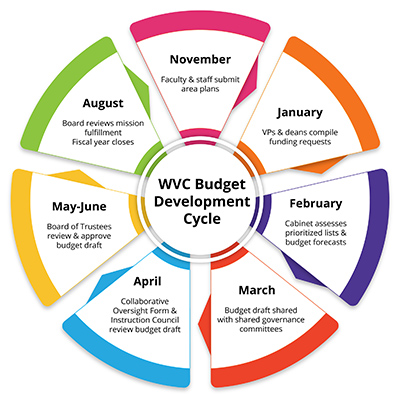 The WVC Board of Trustees adopted Policy 600.101 - Operating Budget Development and Monitoring in January 2026. This policy aligns with accreditation standards and uses a budget development process that is intended to solicit, prioritize, and allocate resources in an inclusive way. The process is designed to ensure that resource allocation is centered on WVC's mission fulfillment, directed
by the strategic plan, and built from local area planning efforts. The intent of this process has been to ensure that key stakeholders are able to provide input into resource needs and priorities, that the budget will be
built in a timeline that allows for budget committee feedback, and that recommendations
for approval are obtained through shared governance.
November: Area plans are submitted by academic programs and college departments. These plans identify gains, gaps, and goals, and may include specific budget requests to support future initiatives. Deans, vice presidents, and supervisors provide employees with feedback.
January: Instructional deans, the dean of Strategic Enrollment and Student Success, and/or the vice president of Student Affairs compile the funding requests identified in area plans. These requests are prioritized into one spreadsheet by the appropriate vice president to feed into the budget prioritization process.
February: Cabinet combines the prioritized lists and considers available allocations in concert with fiscal forecasting, state and federal allocations, and other revenue/expense streams, such as grants.
March: A draft budget is then created for distribution and shared governance committees in March prior to board review and approval.
March-June: Draft budget advances to the Board of Trustees for approval before commencement and the end of the fiscal year.
Current Budget
Notice: These documents are management reports prepared using internal data extracted from WVC's ctcLink accounting system. These reports are intended solely for internal management review. They have not been audited, reviewed, or verified by an independent certified public accountant, and they should not be construed or used as an audited financial statement.
Archived Budgets
FAQs
The National Association of Colleges and University Business Officers (NACUBO) recommends a minimum of three to six months of operating costs be placed in reserves to ensure financial stability during times of financial uncertainty. The Board of Trustees policies require 40% of the operating budget, approximately $16 million for fiscal year 2026-2027. The current balance of identified reserves at the end of fiscal year 2026 is approximately $2 million, and the college is expected to increase this after the audit is finalized and adjusted. For the fiscal year 2027 budget, a contingency has been built in to help deal with mid-year adjustments. This is presented as a separate department in the Budget Variance Report (BVR).
WVC has made a significant number of adjustments and reconciliations that stem from the 2021 conversion to ctcLink. While there are still discrepancies that are being identified and adjusted, the material ones have been handled. WVC has a contract with Clark Nuber to perform the auditing of the 2026 financial statements, which will begin Fall Quarter 2026. The expectation is to meet the accreditation timeline for the 2026 audited statements as well as the prior years dating back to the conversion.
To increase financial transparency, WVC drafted a new policy for systematic financial reporting to the board that includes provisions for establishing reasonable projections, opportunities for campus review and input, and a timeline for development and approval. The board approved the policy on February 18, 2026.
The vice president of Finance and Administration is working with the president, cabinet, and Budget Committee to establish realistic financial resource forecasts to drive mission-driven expenditure levels and produce a budget that is approved by the board in a more timely manner in future years.
The Fiscal Services (business) office has been reorganized with a focus on effective use of the enterprise system (ctcLink) so that all levels of our campuses can monitor and assess timely and accurate data. WVC also recently hired a new accountant, controller, assistant controller, and vice president of Finance and Administration. Changes were also made to the budget function and staffing with the intent to provide the campus with timely, accurate, and understandable budget management tools. For fiscal year 2027, the budget was presented to the campus prior to the first reading by the Board in May and final approval in June 2026.
The WVC Budget Committee was established by the president and is comprised of faculty and staff from both campuses. The purpose of the Budget Committee is to understand the operating budget sources and uses of funds, monitor the progress of the current year, upcoming challenges and opportunities, provide campus-wide perspectives, and communicate to the campus community about budget issues.
The budget committee begins meeting in fall quarter, with a review of the current year budget after fall-quarter enrollment and fiscal impacts are available. The committee presents to the campus the first drafts of the budget for the upcoming year before the end of winter quarter. The final draft of the budget is presented to the campus community in spring quarter, with time for input and modifications. The Board of Trustees begins the first reading at their May meeting and gives final approval to the budget at their June meeting.
The Fiscal Year 2028 budget process will begin in October 2026, with the first campus meeting and a first quarter budget status report to the Board.
While collaborative and inclusive, the final budget is the responsibility of the college president, with final approval from the Board of Trustees.
WVC's operating budget is comprised of federal, state, and local revenue sources. This includes state allocations, tuition and fees, and Running Start. Since grant funds are specific as to timing, use, and programming, they are generally not included in the operating budget. WVC is considering how to utilize ctcLink for reporting in the future, but the majority of the impact is minor compared to the operating budget.
Unlike operating revenues and expenditures, which have a specific fiscal year (July 1 through June 30), grant funding has variable timelines ranging from a few months to over three years. Grant funds also have very specific outcomes and allowable expenditures that require separate and specific accounting. Due to these differences, if grant funds were broadly incorporated into the operating budget, the result would be a more complicated and confusing report. The college is working on a separate report for grant funding that will help communicate the impact of these resources to the mission of WVC.
Steve Ward (serving as interim vice president of Finance and Administration) reorganized and streamlined fiscal operations, hired qualified staff, and established a transparent, proactive budgeting process with broad-based participation. He also assisted in the hiring of a new, permanent vice president, Geoff LaHaie, who will continue those efforts and has significant experience in community college budget processes and audit filing. A new controller, Nick Crawford, and an assistant controller, Jorge Orozco Valencia, were also hired; they have extensive accounting backgrounds and experience in reconciling preparation of audited financial statements.
This team is currently preparing financial statements to be audited by Clark Nuber. This process should take most of the 2026 fall quarter with finalization in winter quarter 2027.
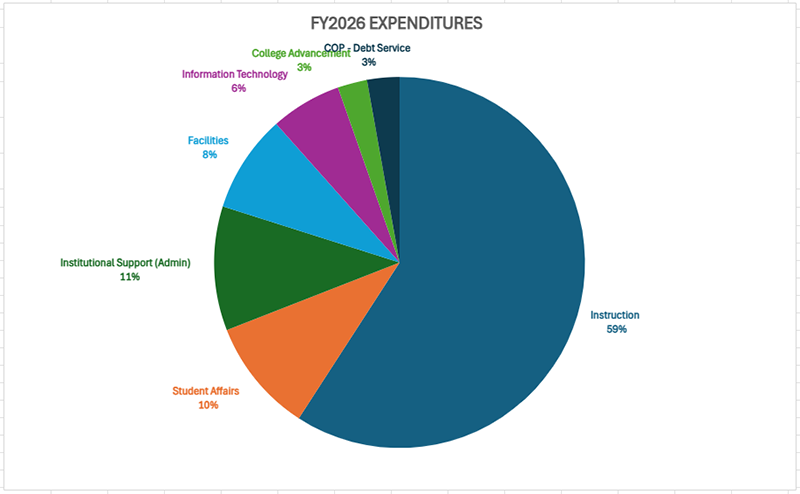
As demonstrated in the graph below, WVC's expenditures are as follows:
- Instruction: $23,380, 619.86 (59% of operating budget)
- Student Affairs: $3,929,541.17 (10% of operating budget)
- Institutional Support (Admin.): $4,277,250.21 (11% of operating budget)
- Facilities: $3,373,323.33 (8% of operating budget)
- Information Technology: $2,446,806.81 (6% of operating budget)
- College Advancement: $1,016,612.91 (3% of operating budget)
- COP - Debt Service: $1,114,287.50 (3% of operating budget)