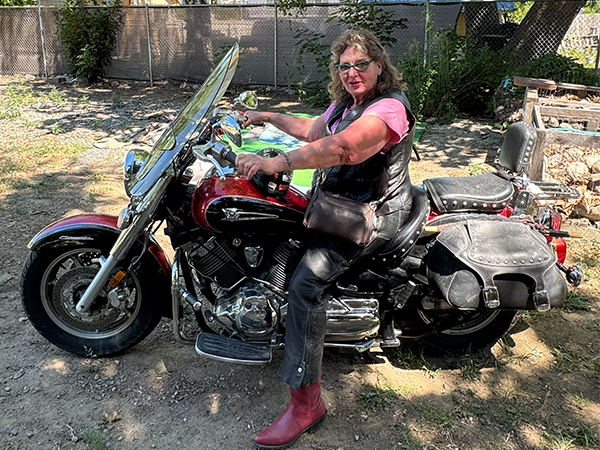
Meet Barbara Oldham. With an appetite for adventure and curious nature, Barbara has logged dozens of motorcycle trips around the Pacific Northwest, and has dedicated her career to guiding students through college: “You just jump in, if you’re adventurous. And I apparently am a little adventurous,” she laughs. Barb has worked at Wenatchee Valley College as a reference librarian for the past 18 years, and just before she rode her motorcycle off into retirement, she reflected on her time at WVC, and her journey from dropping out of high school to becoming a librarian.
Born in Colorado and raised in Idaho, Utah and Oregon, Barbara’s yearning for adventure began with a love for reading. At age ten, she created a mini library in her garage for the neighborhood kids. “I wanted to be a librarian, or a bookshop / tea shop owner. So that was my goal when I was ten. Well, fast forward — life goes on, I forget that that's what I wanted to do and be,” she shared.
Barbara dropped out of high school around tenth grade. “I didn’t need it – it was a different time,” she said. She would discover later in life that she had undiagnosed ADHD, which she felt explained her tendency to procrastinate, but as a youth, Barbara found her passion in motorcycles, which also offered a tight circle of friends. She recalls this chapter of her life fondly, and shared that her perspective changed once she became a mother. Her waitressing job wasn’t enough to support her and her daughter, so she took her mom’s suggestion to move in with family in Kansas and go back to school.
Thanks to a generous family friend that agreed to pay for her GED, Barbara enrolled at Washburn University in Topeka, Kansas – “a city school, four-year school, but it had the atmosphere of a community college,” she recalls. She also credits the Welfare-to-Work program of the era, which removed one of the biggest barriers that parents face: paying for childcare.
A skill alignment test identified teaching as a potential career path for Barbara, and she began working toward her Bachelor’s in Education with an emphasis on science and social studies. An English 101 professor noticed Barbara’s inclination towards writing, and suggested she take honors classes, an experience she really enjoyed. “They were just interesting, and the share-out — we got to engage in each other's final products. I feel like I learned way more because I was learning from my colleagues,” she said.
Improving as a writer, though, had its challenges for Barbara─namely, grammar. She was missing some basic foundational knowledge, but she didn’t give up on herself. “I always went to the writing center before I turned in a new paper and kept getting them to explain to me what a sentence fragment was… [and] I got there. I made it through,” she said.
After graduating, Barbara started substitute teaching as a fourth and fifth grade teacher and quickly feared she’d made a mistake. She loved the school atmosphere, but she didn’t see herself teaching younger kids. A friend suggested she consider becoming a librarian since it’s different than being in the classroom, which is when it hit for Barb: “Ding — the light bulb goes off: ‘Oh yeah, that's what I wanted to do when I was ten!’”
Barbara applied and was accepted to the Master’s in Library and Information Science program at Emporia State University in Kansas, and she loved it. The grammar hurdles, however, persisted. “I did almost get booted out of library school for lack of foundational knowledge, but I managed to get by it and stay in,” she recalled. Her professors recommended she revisit some writing basics and gave her the chance to do so¾their support made the difference.
Thanks to her graduate studies and work study job in the Emporia law library, which turned into a job, Barbara saw how many people misunderstand and underestimate what librarians do, and how important they are for linking data to learning outcomes. She was part of the school librarians’ association in Kansas that was the first in the state to write benchmarks (learning outcomes) for library programs.
After graduate school, Barbara worked as an elementary and high school librarian in Topeka. Thanks to software trainings she’d completed and her knack for adventure, Barb took on the electronic services part of the library and taught research skills to high school students.
Like a long motorcycle trip that eventually winds its way back home, Barbara’s professional path kept her on a slow move back to the west. After her time in Topeka, Barb took a reference librarian job at Spokane Falls Community College where she helped the satellite campuses implement their distance education models.
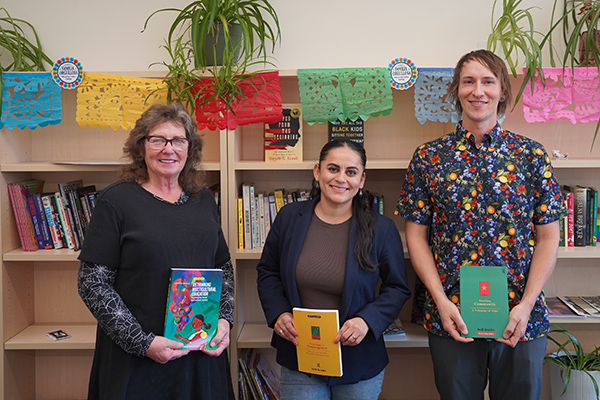 In 2008, Barbara interviewed for the reference librarian position at Wenatchee Valley
College and was offered the job, a role she’s occupied with great joy. “I couldn't have
picked a better job if I'd custom-written it. You can change up what you're doing, you
never get bored. There are so many things you can do,” she said. Reference librarians frequently focus
on the instructional aspects of library use, teaching students from a wide variety
of disciplines how to develop their research skills and navigate the multitude of
resources at their disposal. Being able to work with a variety of students, faculty,
and staff has been one aspect of library work that Barb has enjoyed most.
In 2008, Barbara interviewed for the reference librarian position at Wenatchee Valley
College and was offered the job, a role she’s occupied with great joy. “I couldn't have
picked a better job if I'd custom-written it. You can change up what you're doing, you
never get bored. There are so many things you can do,” she said. Reference librarians frequently focus
on the instructional aspects of library use, teaching students from a wide variety
of disciplines how to develop their research skills and navigate the multitude of
resources at their disposal. Being able to work with a variety of students, faculty,
and staff has been one aspect of library work that Barb has enjoyed most.
Looking back on her life, Barb suggested that “It looks like I had a plan and everything worked out for the best. But I had no plan — it's all an illusion. I mean, it all did work out for the best, but I never had a single plan.” Although she dropped out of high school, Barbara found her way back to her education, and her story serves as a reminder that everyone has a unique path and timeline. When asked what she’d like to share with students and future generations, Barbara was quick to highlight the value of lifelong learning and social connection: “Keep coming to school. Be a lifelong learner. And [stay] curious.”
 Barb maintains faith in this generation’s capacity to bring about needed change, though she’s concerned
about the science that points to technology’s harms, especially AI, on kids. Still, she’s hopeful.
“We need to change the culture from ‘right answer’ to creative thinking. And we need
students to persist, and to use [AI] as a tool — not to replace their learning, because
then they won't even be able to,” she shared.
Barb maintains faith in this generation’s capacity to bring about needed change, though she’s concerned
about the science that points to technology’s harms, especially AI, on kids. Still, she’s hopeful.
“We need to change the culture from ‘right answer’ to creative thinking. And we need
students to persist, and to use [AI] as a tool — not to replace their learning, because
then they won't even be able to,” she shared.
There are many ways to know that Barbara is a librarian at heart: her insatiable curiosity, her tenacity in pursuing a research question, her ability to quickly scan and process information. Perhaps the most poignant is her belief in what libraries offer humanity and her joy in helping others learn. “Libraries across the board, no matter what kind, level the playing field,” Barb said. “The work itself, the students—[they're] very positive motivation. And when you get that full circle with the students, where they come back later and tell you something you did made a difference for them—it really gives you purpose, to know you 've made a difference. It’s the best job ever,” Barbara shared.