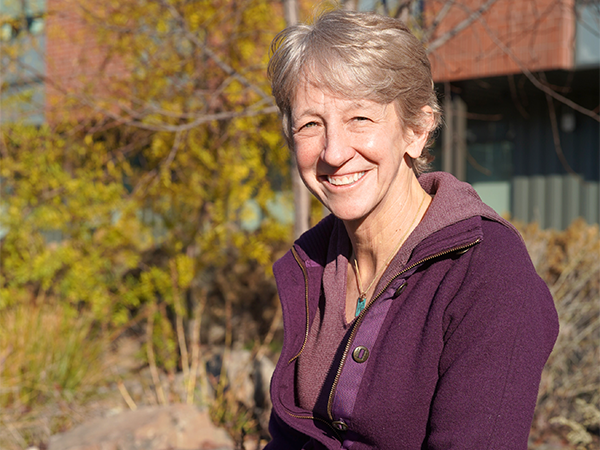
Author and English faculty member Ana Maria Spagna wanted to write as soon as she was old enough to tell stories. As a child, she “loved living in books” such as “Little House on the Prairie,” the Nancy Drew series, “The Phantom Tollbooth,” and more. Her love of writing dimmed in middle school, around the same time that she lost her father, and didn’t reignite until she began working in and discovering the beauty of the natural world.
When she was 13 years old and living in Riverside, Calif., some neighbors took Ana Maria on a camping trip to Oregon. After that, she went home and told her mother she would be moving to Oregon one day, a promise that she fulfilled when she left for university. She earned her bachelor’s degree in English Literature from the University of Oregon. “It was paradise when I landed there [in Eugene],” she said. Ana Maria initially thought that she would continue on to law school. “It turns out I don’t like conflict,” she said. When she came across a postcard for the National Park Service in a hallway at the U of O, her career working on a backcountry trail crew began, and her writing spark returned.
Ana Maria worked for one season at Canyonlands State Park, and then she moved to the Lake Chelan area to work on the backcountry trail crew for North Cascades National Park, an area that she found so beautiful that she was compelled to write about it. “I just loved the natural beauty of the mountains, and rivers, and trees, and I would camp out for eight days at a time on trail crew, so I spent a lot of time in the backcountry.... That was my 100 percent passion,” she said. She felt like something was missing in her writing, though. “There wasn’t energy or momentum to it,” Ana Maria said.
She returned to school and began a trend of majoring in another area of writing than what she normally wrote. Ana Maria was primarily writing essays at the time, but at Northern Arizona University, where she earned her Master of Arts degree, she studied fiction writing and read the works of nature writers and essayists such as Annie Dillard, Joan Didion, and James Baldwin. “My essays needed the momentum that fiction can offer,” Ana Maria explained. “I needed to give it some kind of arc, some kind of movement.... I really needed that fiction writing training to push it along.”
After working for the NPS for 15 years, and her first book published, “Now Go Home: Wilderness, Belonging, and the Crosscut Saw,” Ana Maria was offered an opportunity to teach online from Stehekin. She was then offered more opportunities to teach in person as a visiting writer at different universities. “I found that I really loved teaching in person,” she said. Ana Maria taught creative nonfiction, nature writing, writing the non-human (when animals or parts of the environment are the narrators), and queer ecologies at schools such as Whitman College, the University of Montana, and St. Lawrence University in Canton, New York. In her effort to become a full-time teacher, Ana Maria returned to school.
At Fairfield University, Ana Maria’s mentor encouraged her to study something she didn’t know about and recommended poetry—another medium that Ana Maria didn’t usually write in. “It was hard, and it was wonderful,” she said. She earned her MFA in Poetry and went on to publish a book of poetry, “Mile Marker 6.” She encourages other writers to explore this cross-pollination of writing and to study the types of writing that they may be unfamiliar with.
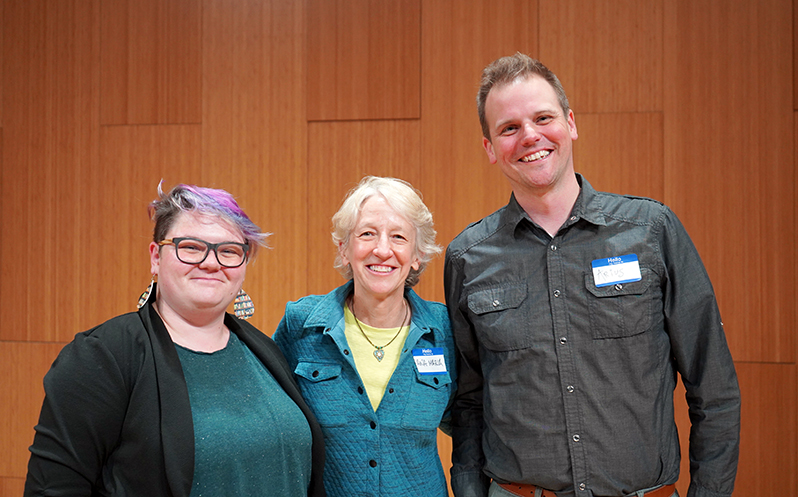 Ana Maria now teaches English courses at WVC, where she also serves as faculty advisor
for WVC’s literary journal, Mirror Northwest, and assists with the WVC Visiting Writers
Series. “I enjoy just the excitement of receiving student essays. I like hearing their
stories and helping them to make their writing stronger and to use their own voice;
that is super exciting to me. I think it took me a long time working all on my own
to figure it out, and if I can help speed that along for writers, that’s terrific,”
Ana Maria said.
She recommends to all emerging writers, “follow your passion and look for opportunities to learn, in whatever way that is—learning writing techniques or learning more about a history of a region.”
It was when she was exploring the history of this region for a book she was writing about Indigenous people reclaiming their lands that Ana Maria learned about the Chelan Falls Massacre. That event became the focus of her book “Pushed: Miners, a Merchant, and (Maybe) a Massacre,” published in 2023, and also the focus of her upcoming WVC Speaks lecture on Nov. 19. What Ana Maria discovered was this: According to lore, one day in 1875 a large number of Chinese miners—perhaps as many as three hundred—were murdered, their bodies pushed over a cliff into the Columbia River. She had found information in a small, museum-type booklet and wondered if it could be true. During that time, she was teaching at Whitman and had access to their archives. “I was like, ‘Oh, I’ll find an answer for sure. And I found all kinds of cool stuff, but not an answer,” she said. Research for “Pushed” took five years. “I learned so, so much about the Chinese of the region and the history of the region,” she said. She will share her research about the massacre, including encounters with historians, archaeologists, Indigenous elders, and migrant workers, during her WVC Speaks lecture. She will also explore the rich history of Chinese immigrants in North Central Washington and compare their experiences with contemporary immigrant communities.
Her research has changed her perspective about the Lake Chelan area, where she lives and has worked. “When I first moved there [to Stehekin] and worked for the Parks Service, like everybody just said, Later, however, an archaeologist for the park did research in the backcountry and found 300 sites, confirming that the Indigenous people had lived in the area. Ana Maria’s research also confirmed that the Chinese had lived in the area. “There’s just a richer human history. I think of a wilderness as being unpeopled, but it was never unpeopled,” she said.
Her research also emphasized how embedded xenophobia is in the nation’s history.
During her WVC Speaks lecture, Ana Maria will also briefly discuss her latest book, “Coiled,” which was released on Nov. 1. “Coiled” considers topics such as nature and who our kin are. “So our kin are not only immigrants and other humans but also the animals and the rivers and so forth,” she explained. The book can be found locally at A Book for All Seasons in Leavenworth and Fable Books and Blooms on Wenatchee Ave. It can also be ordered online from Powell’s and from the publisher, the University of Nebraska Press.
Ana Maria hopes that her WVC Speaks audience will take away “a broader understanding of the history of the region, and of xenophobia, more broadly in our history, meaning American history, not just Wenatchee and Chelan.” It’s an important issue for people to understand, Ana Maria said, “because history is repeating itself right now in dangerous ways.”
“I’ve spoken about this book lots of places, but it’s really different and exciting to do it in the place that it’s about,” she said.