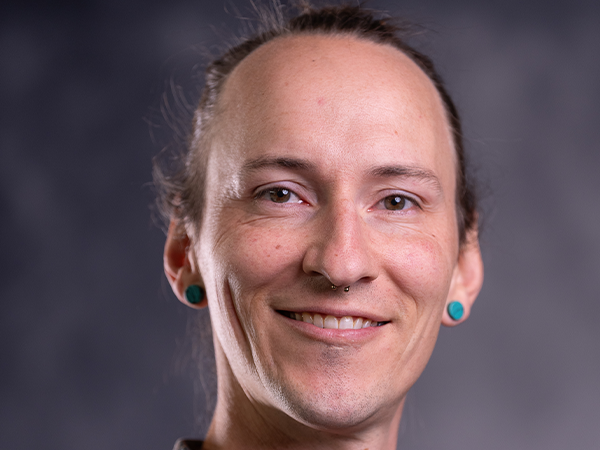
Saxon Spillman was around nine years old when his father, a non-traditional college student, would bring home thought experiments and philosophical ideas from his philosophy courses and share them with Saxon. Some of those philosophical discussions included the problem of evil and the meaning of words. He was simultaneously learning about Buddha and Buddhism, and developing a love of the outdoors. All of these elements would eventually come together to shape Saxon’s future work as an educator and ally.
Saxon originally pursued an engineering program in college, but, following a struggle with calculus and engineering physics courses, he elected to switch to philosophy. He gained more of a formal Buddhist training during his undergraduate schooling. “I was very intrigued by all of the wisdom and traditions [of Buddhism],” Saxon said. Through Buddhism, he explored ethics, morals, and how to be a good person in the world.
Saxon’s mentors knew he was interested in Buddhism and encouraged him to pursue non-Western philosophy. He completed a capstone project while he was in an exchange program in Nepal that included sitting among students in a Buddhist monastery and learning from the monks there who were discussing ancient texts. “It was so, so powerful,” Saxon said. “I made some cool friendships and connections and learned a lot, so that spurred me on to grad school.” He chose the University of New Mexico, where he earned an MA in Philosophy.
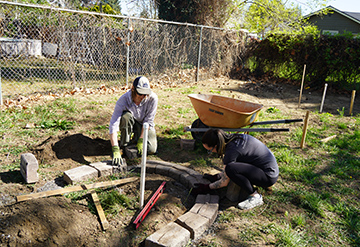 Before joining WVC as a part-time humanities instructor, Saxon was an outdoor educator—he
taught skiing, including cross-country and downhill, along with rock climbing and
backpacking. He also worked in emotional intelligence education in a therapeutic,
outdoor treatment program. During his undergraduate education, when his mentors encouraged
his study of non-Western philosophy, they also recommended teaching. Saxon began observing
his teachers, “not just as a student trying to learn but as someone thinking about
teaching like them,” he said. “It just seemed great migrating from one side of the
classroom to the other. I get to keep having the same conversations. And now I get
to do it with more people every day.”
Before joining WVC as a part-time humanities instructor, Saxon was an outdoor educator—he
taught skiing, including cross-country and downhill, along with rock climbing and
backpacking. He also worked in emotional intelligence education in a therapeutic,
outdoor treatment program. During his undergraduate education, when his mentors encouraged
his study of non-Western philosophy, they also recommended teaching. Saxon began observing
his teachers, “not just as a student trying to learn but as someone thinking about
teaching like them,” he said. “It just seemed great migrating from one side of the
classroom to the other. I get to keep having the same conversations. And now I get
to do it with more people every day.”
At WVC, Saxon is teaching Introduction to Humanities, a class that he loves for its flexibility. Depending on students’ interests, he can lean into certain topics. “I actually prefer the humanities for its flexibility, and I can get a little bit rigorous if I want to and the vibe is right, but I can also back off and be more general. And be more accessible.... Some of that philosophy stuff is not what people are into, and they didn’t sign up for a philosophy class, but sometimes they are into it, so we go a little farther.”
He encourages students to take humanities and philosophy courses so that they can explore critical thinking and questioning. “There’s more opportunity to not just do critical thinking, but to think about critical thinking and to feel it out and to explore what that means rather than just be told, ‘Hey, we’re doing critical thinking about X, Y, or Z,’” he said. “That willingness to question yourself or question what other people are saying, that’s just crucial.”
As someone who spent much of his life playing, living, and teaching outside, he hopes that some day he can also take his classroom outside. “I just have preferred living more simply. Being outside recharges me and gives me a lot of energy,” he said. He noted that some institutions teach entire classes or an entire semester outside. “It may be me and a couple other faculty who teach a few classes for an entire quarter in the back country or something like that, and I think that could be really cool,” he said.
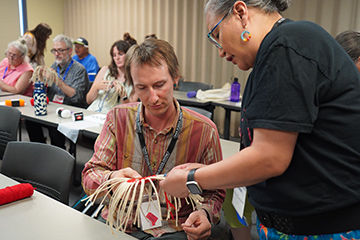 He is also exploring an opportunity to be an ally to the Colville Confederated Tribes.
WVC is the recipient of a Capacity-Building Grant from the Educating Character Initiative,
a project of The Program for Leadership and Character at Wake Forest University. Saxon
serves as the project director, in collaboration with Dr. María Morales-Sánchez, director
of WVC’s El Corazón Teaching and Learning Center, and Lynn Palmanteer-Holder, who
serves as the subject matter expert and tribal liaison. “Indigenizing Leadership and
Character Education” will establish a collaborative cohort of 30 participants, comprised
of WVC staff, local leaders, and educators. Through workshops, community conversations,
and collaborative planning, participants will plan and participate in four workshops
focused on building understanding around leadership, Indigenous epistemology, tribal
sovereignty, and their intersection with character education. The goal is to produce
a shared toolkit of core values, recommendations for future programming at WVC, and
a foundational grounding in tribal sovereignty and relations via the John McCoy (lulilaš)
Since Time Immemorial: Tribal Sovereignty in Washington State (JMLSTI) curriculum.
He is also exploring an opportunity to be an ally to the Colville Confederated Tribes.
WVC is the recipient of a Capacity-Building Grant from the Educating Character Initiative,
a project of The Program for Leadership and Character at Wake Forest University. Saxon
serves as the project director, in collaboration with Dr. María Morales-Sánchez, director
of WVC’s El Corazón Teaching and Learning Center, and Lynn Palmanteer-Holder, who
serves as the subject matter expert and tribal liaison. “Indigenizing Leadership and
Character Education” will establish a collaborative cohort of 30 participants, comprised
of WVC staff, local leaders, and educators. Through workshops, community conversations,
and collaborative planning, participants will plan and participate in four workshops
focused on building understanding around leadership, Indigenous epistemology, tribal
sovereignty, and their intersection with character education. The goal is to produce
a shared toolkit of core values, recommendations for future programming at WVC, and
a foundational grounding in tribal sovereignty and relations via the John McCoy (lulilaš)
Since Time Immemorial: Tribal Sovereignty in Washington State (JMLSTI) curriculum.
“I’ve desired to be an ally to BIPOC or minorities or people that are oppressed in any way. I’ve been able to, but when it comes to Indigenous folks, it’s been really confusing, and I’ve been pretty nervous and anxious about how to go about it,” Saxon explained. He attended the Washington State Indian Education Summer Teaching Institute at Omak in 2025, where tribal members offered pathways to become an ally. After the summer teaching institute, Saxon began exploring grants and worked with María and Lynn to apply for the Capacity-Building grant. They had their first meet-and-greet with tribal members in Omak and Wenatchee in early October, with upcoming ones scheduled for Nespelem and the Methow.
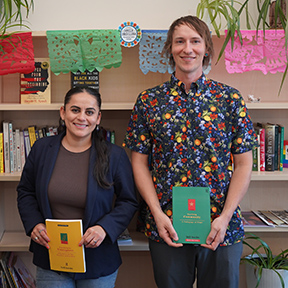 The outcome of the project, he said, would be an Indigenous leadership character model
that represents our region and the values of the Colville Confederated Tribes, one
that could be shared among and adapted by other institutions, who could then add their
own place-based values.
The outcome of the project, he said, would be an Indigenous leadership character model
that represents our region and the values of the Colville Confederated Tribes, one
that could be shared among and adapted by other institutions, who could then add their
own place-based values.
Saxon will be sharing his love of philosophy—and two of his favorite philosophers, Socrates and Buddha—in his upcoming WVC Speaks lecture, “Ancient Philosophers: Socrates and Buddha,” on Oct. 22 in The Grove Recital Hall on the Wenatchee campus. In this lecture, Saxon will explore what it means to live a good life from an ancient perspective while donning a contemporary, cross-cultural lens. Though each thinker was separated from the other by significant time and space, their parallels as catalysts for historic change are undeniable, and their societal impacts are readily witnessed even today. Beyond mere historical curiosities, Saxon will argue that, with a philosophical and cross-cultural approach, we can helpfully apply lessons from the past to address problems of the present.
“They both agree that ignorance is the problem.... And they both have recommendations about how to live a better life,” Saxon explained. While their recommendations for living a better life diverged, both philosophers shared a similar intention—to help people. “They may not agree on the nature of reality or the path to a better life, but they do agree that people are in this place where they need some help, and the end result is there’s a better way to live for all of us,” Saxon said. “And so we don’t have to agree about very much at all. And we can still carry on the same goals and same work right alongside each other.”
“Their messages were so profound,” he continued. “At the time, they caused some pretty big waves, but they have stood the test of time, too,” he said. “We’re still gaining insights about our lives through this old story [from] 2,500 years ago.”
Saxon hopes that people who attend his lecture learn an appreciation for the value of philosophy and for non-Western philosophies. “It’s okay to look at other people for wisdom,” Saxon said. “It’s okay to disagree and still work together. Disagreement does not have to end collaboration.”